Shaping the green heat supply of tomorrow together.
Together with our customers, we are already shaping the green heat supply of tomorrow.




























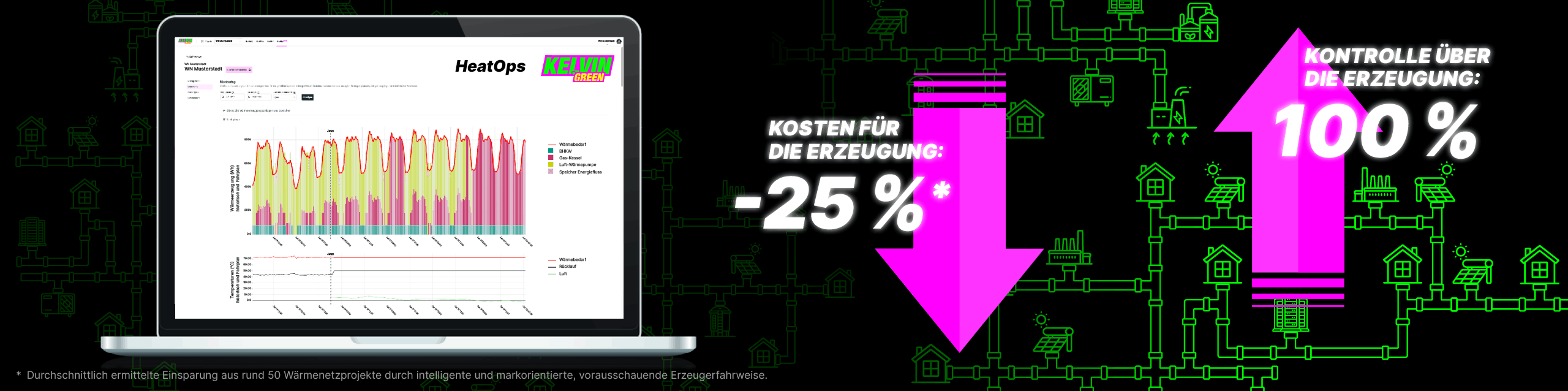
Kelvin Green helps you operate your heating network sustainably – and up to 30% more affordably.
The heating sector is mandated to become climate-neutral by 2045, and district heating networks play a pivotal role in achieving this goal.
However, as a heat supplier, you face a significant challenge: your existing networks must transition to climate neutrality; new green heating networks must be developed in accordance with municipal heating plans; the cost of heat must remain affordable throughout this process; and all of this must be accomplished using only the skilled workforce currently available to you.
The solution: Digitize, automate, and optimize every possible aspect of your operations to save significant time and money. That is precisely why Kelvin Green has developed an end-to-end operating system designed specifically for your district heating network’s transformation. It covers everything from strategy and planning to the actual operation of your intelligent energy hub.
The results speak for themselves: transformation plans and feasibility studies can be completed with 50% less effort, while average heat generation costs are reduced by 20–30% thanks to intelligent operational management with Kelvin Green. And it’s all delivered as a seamless, integrated solution!
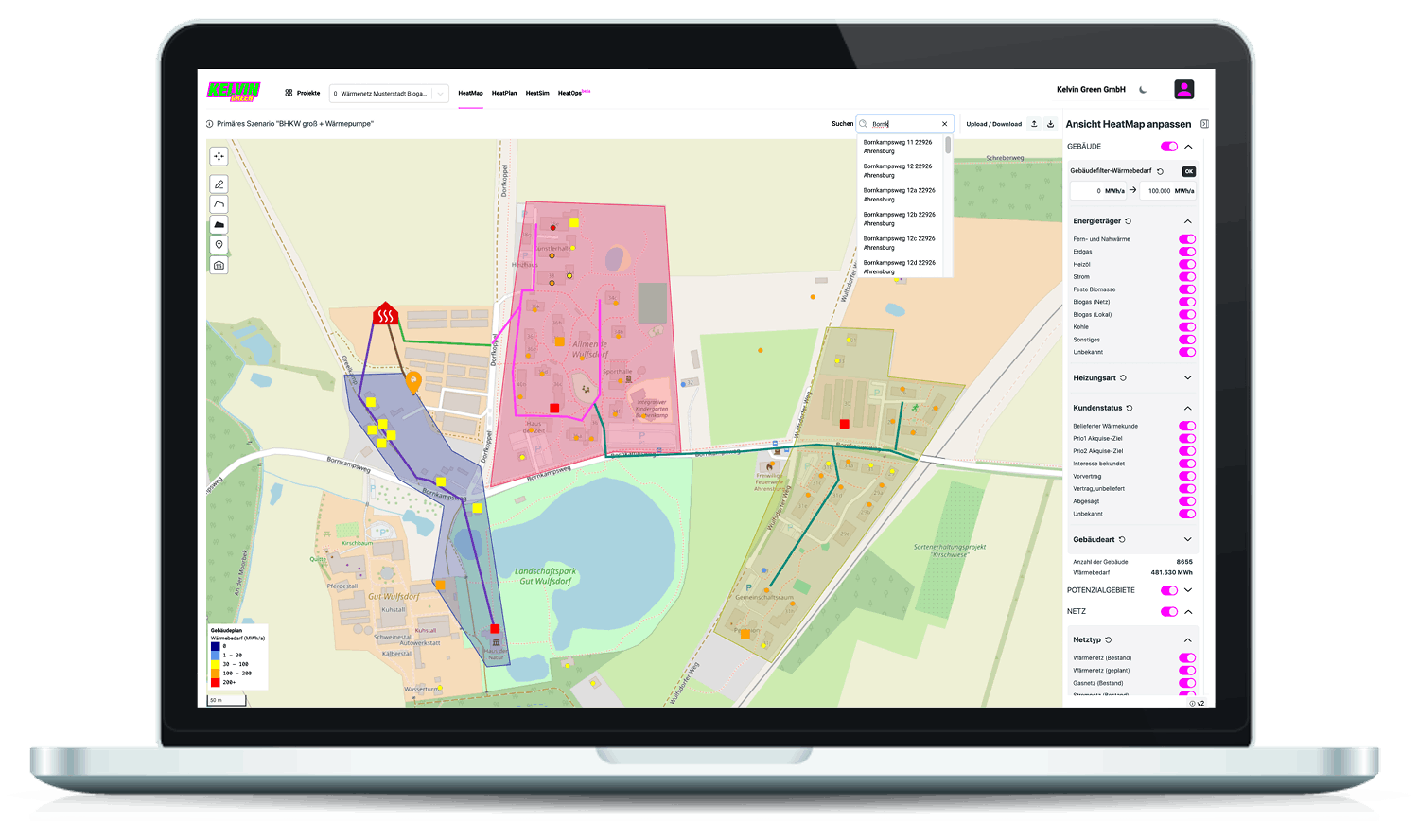
Transformation Plan and Feasibility Study: Fast, Digital, and BEW-Compliant.
A good plan doesn’t have to be expensive. However, it is essential—and, as of December 31, 2026, mandatory. Kelvin Green provides support every step of the way—from applying for BEW funding to the actual implementation of complex transformation plans and feasibility studies. And the best part? Instead of Excel chaos and data clutter, everything is handled efficiently within a single tool – including a consistently up-to-date, print-ready final report that meets all BEW requirements.
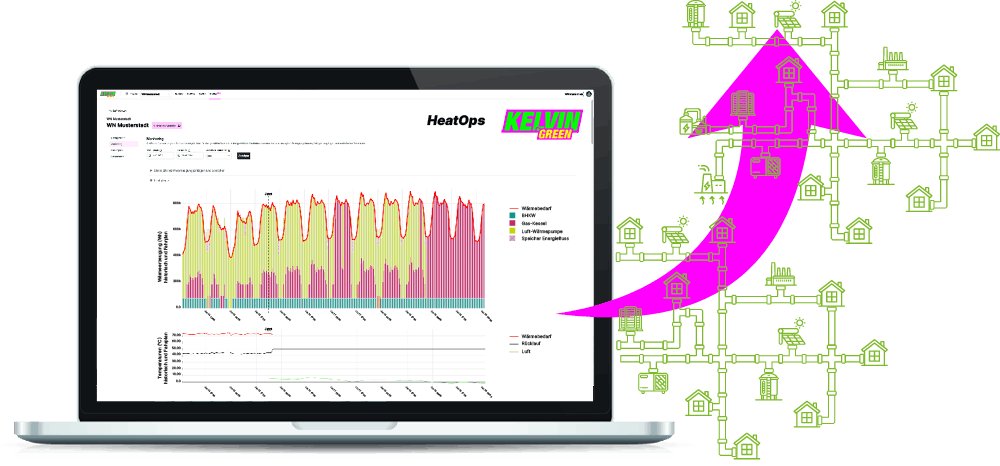
The Intelligent Heating Center: Reduce Generation Costs by Up to 30%.
Green heating networks are becoming significantly more complex: they involve a greater variety of heat generation plants and storage systems, are subject to volatile electricity prices and heat demand, and everything must be seamlessly synchronized and intelligently automated. The good news: through optimized operation, generation costs can be reduced by an average of 20–30%, thereby making green heat a competitive alternative to decentralized, standalone solutions.
Working with Kelvin Green has many advantages.
Competence comes from being able to. The Kelvin Green team.

Martin Bornholdt
A former founder and board member of DENEFF and McKinsey strategy consultant, Martin is responsible for strategy, finance and marketing at Kelvin Green. He also heads the consulting division and thus all topics relating to regulation, promotion, energy markets and transformation strategies

Geert Vanderkelen
As a hardcore geek, Geert develops the software at Kelvin Green – from the data architecture to the front end and ensures that your data is in good hands. Geert knows what he’s doing, with over 20 years of experience at Sun Microsystems, Oracle and the German Cyber Security Organization, among others. Most recently, he was a senior developer at Planetly.

Noah Mertens
As an AI expert and energy and mechanical engineer, Noah is responsible for the complex energy modeling and development of our algorithms at Kelvin Green. He has impressively proven that he can do this in numerous projects at TU Dresden and Fraunhofer IIS for adaptive systems.

Tommy Wohlfahrt
Tommy is a specialist in the development of efficient system solutions. After completing his Masters in Computational Science and Engineering at the Technical University of Dresden, he has already gained many years of experience in algorithms, high performance computing and software development, including at Cofely Deutschland GmbH and the Institute for the Development of Adaptive Systems at Fraunhofer IIS. At Kelvin Green, Tommy uses his deep technical understanding and ability to find innovative solutions to develop an advanced optimizer for district heating networks.

Felix Merschmann
As a trained mechatronics engineer for refrigeration and air conditioning technology and a mechanical engineer (Master’s degree) from Münster University of Applied Sciences, Felix brings practical and academic knowledge of modern heat supply to the Kelvin Green team. Even as a working student, Felix supported numerous customers in heating network transformation projects and is a proven expert in the design and operation of large heat pumps at Kelvin Green. As part of his excellent master’s thesis, he developed a comprehensive simulation model for the real operation of heat pumps, which has been incorporated into our operation optimization software. Felix supports both the product team with questions relating to system technology and our customers in transformation projects.
News from us.
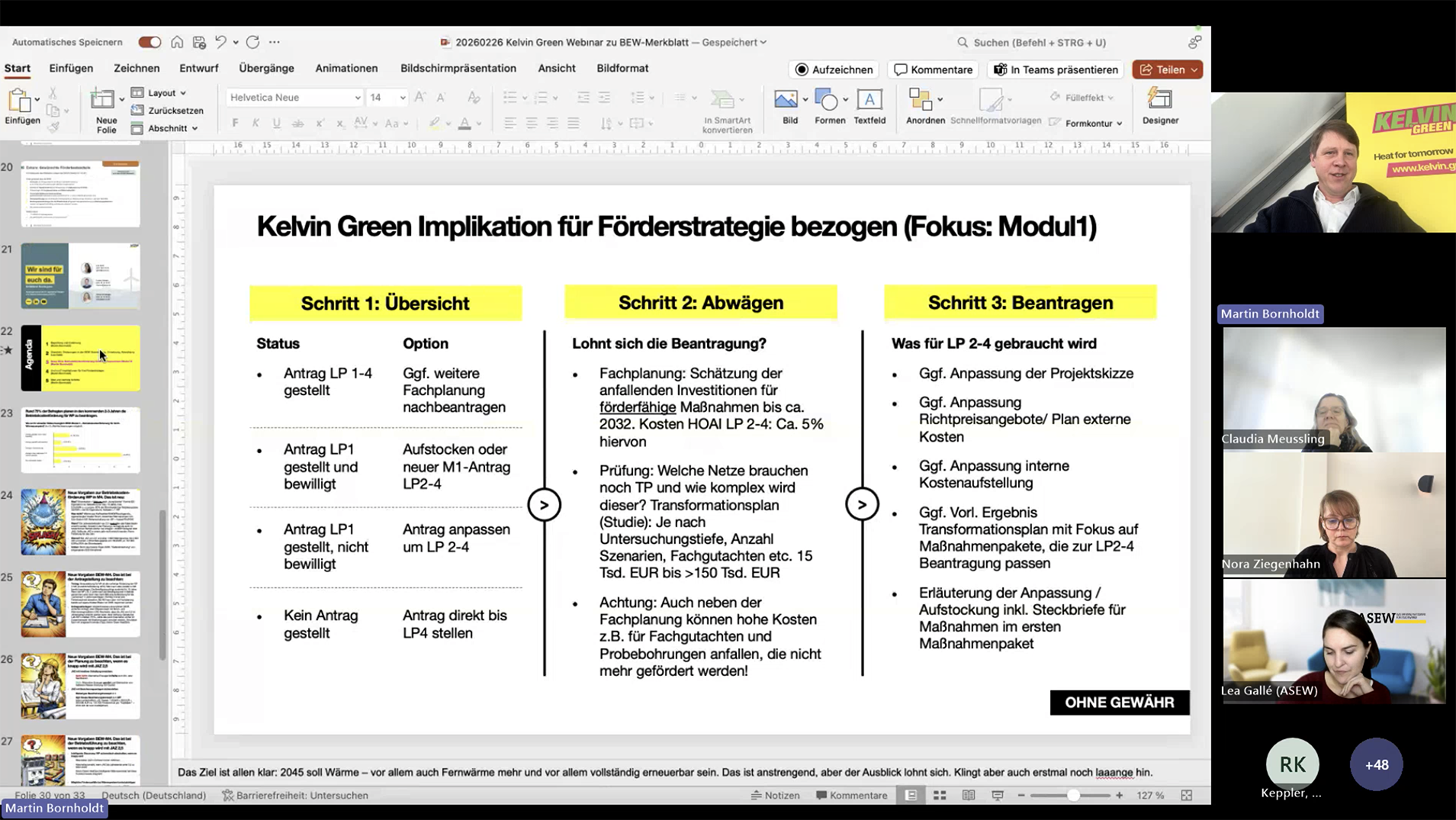
Best practice webinar: Strategic heat (network) planning
More than 80% of customers of municipal utilities and energy suppliers will need a new green heating solution in the next 20 years! This means that the heat cake will be redistributed ...

HEAT EXPO 2025: Latest heating network simulation tools live — see you in Hall 4 · B58
We warmly invite you to HEAT EXPO in Dortmund. Meet the Kelvin Green team for a barista coffee, talk with us about your heating network—and experience our latest heating network simulation tools in compact live demos right at the booth.

Webinar review: Biogas & heating networks – new business models for biogas plants
In our webinar on June 19, 2025, we showed how biogas plants can continue to be operated economically even after the EEG subsidy expires. The strong interest...
Press release: HeatSim revolutionizes heat network planning: Kelvin Green launches new simulation tool at E-World 2025
Innovative tool for heating network operators: HeatSim enables precise operating simulations to optimize heat generation systems...
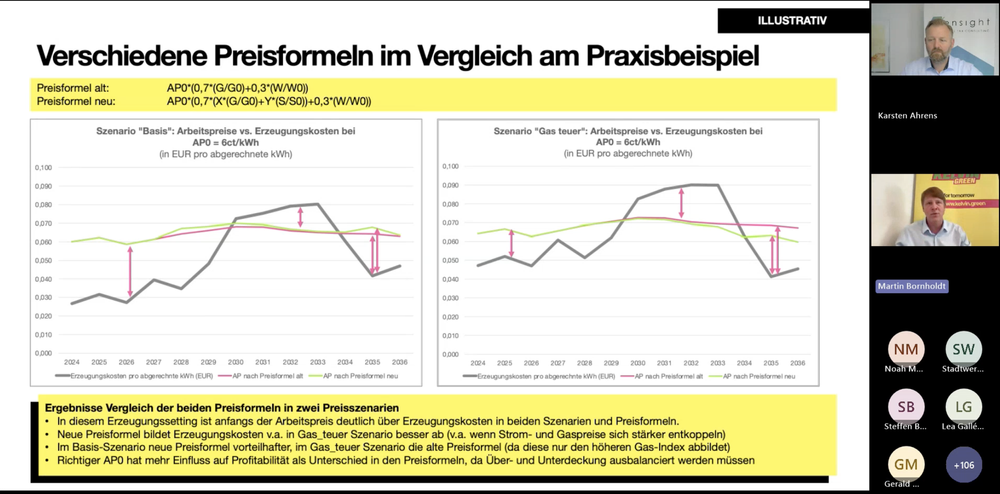
Webinar: AVB&Co: Optimized pricing for green heating networks.
The AVB District Heating Ordinance (AVB Fernwärme-Verordnung), the relevant price regulation for local and district heating, is being fundamentally revised. At the same time, the prime cost structures are changing...

Best practice webinar: Strategic heat (network) planning
More than 80% of customers of municipal utilities and energy suppliers will need a new green heating solution in the next 20 years! This means that the heat cake will be redistributed ...
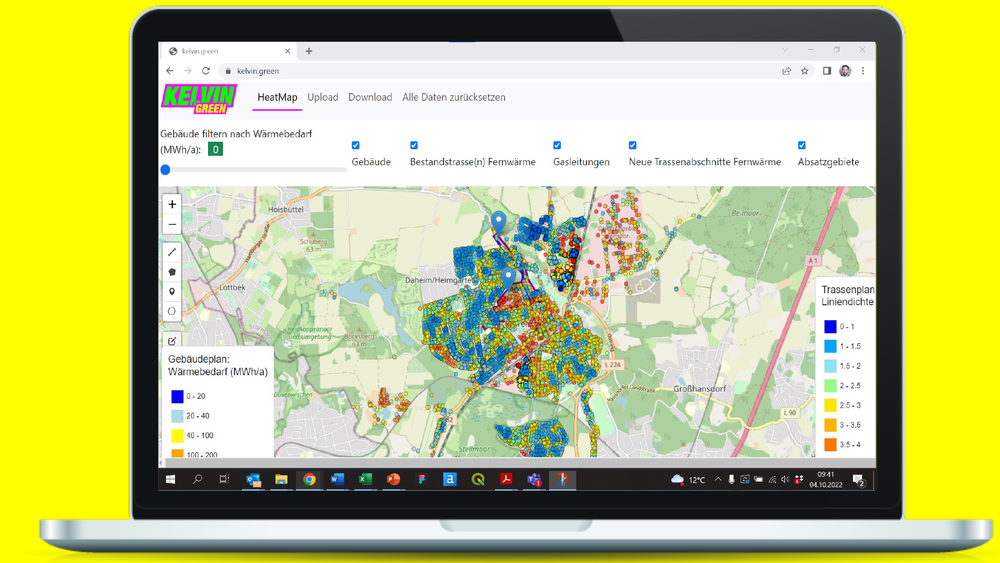
New & helpful: Quick and sustainable BEW transformation plan with Kelvin Green Tools
Tataaa! After almost a year of developing, trying out and testing in practical projects, the time has finally come: Kelvin Green proudly presents...
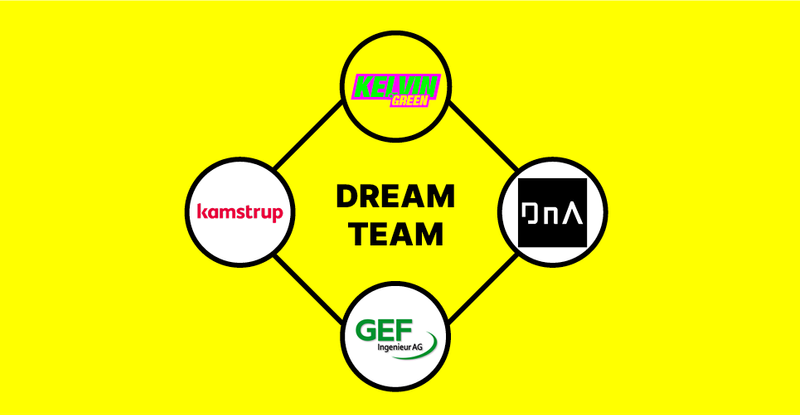
Press release: Kelvin Green wins strategic investors for the development of intelligent district heating network control
Kelvin Green is pleased to announce that Kamstrup A/S, GEF Ingenieur AG and DnA Venture GmbH have become strategic investors in the...

Long-term scenarios of the German government: More and greener district heating by 2045.
In December, the Federal Ministry of Economics published a study on long-term energy supply scenarios. Good News....
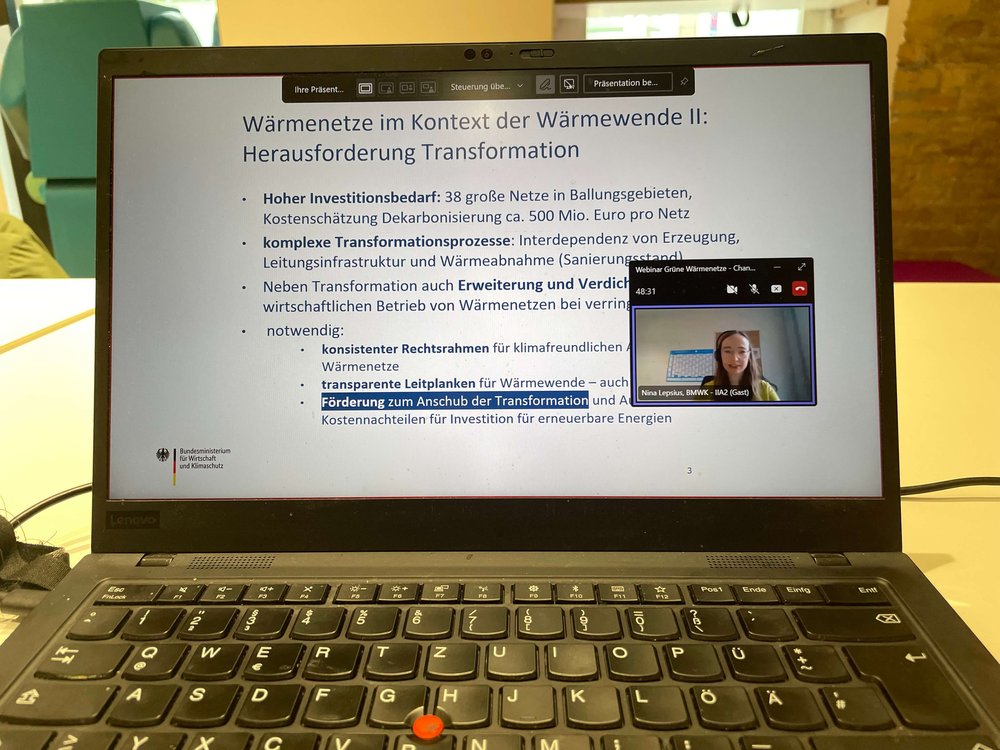
Our first webinar on the topic of “Green heating networks” – definitely not the last!
The interest in our first webinar together with the DENEFF EDL_HUB surprised us: over 150 participants wanted to...
Our partners.

GEF Ingenieur AG